

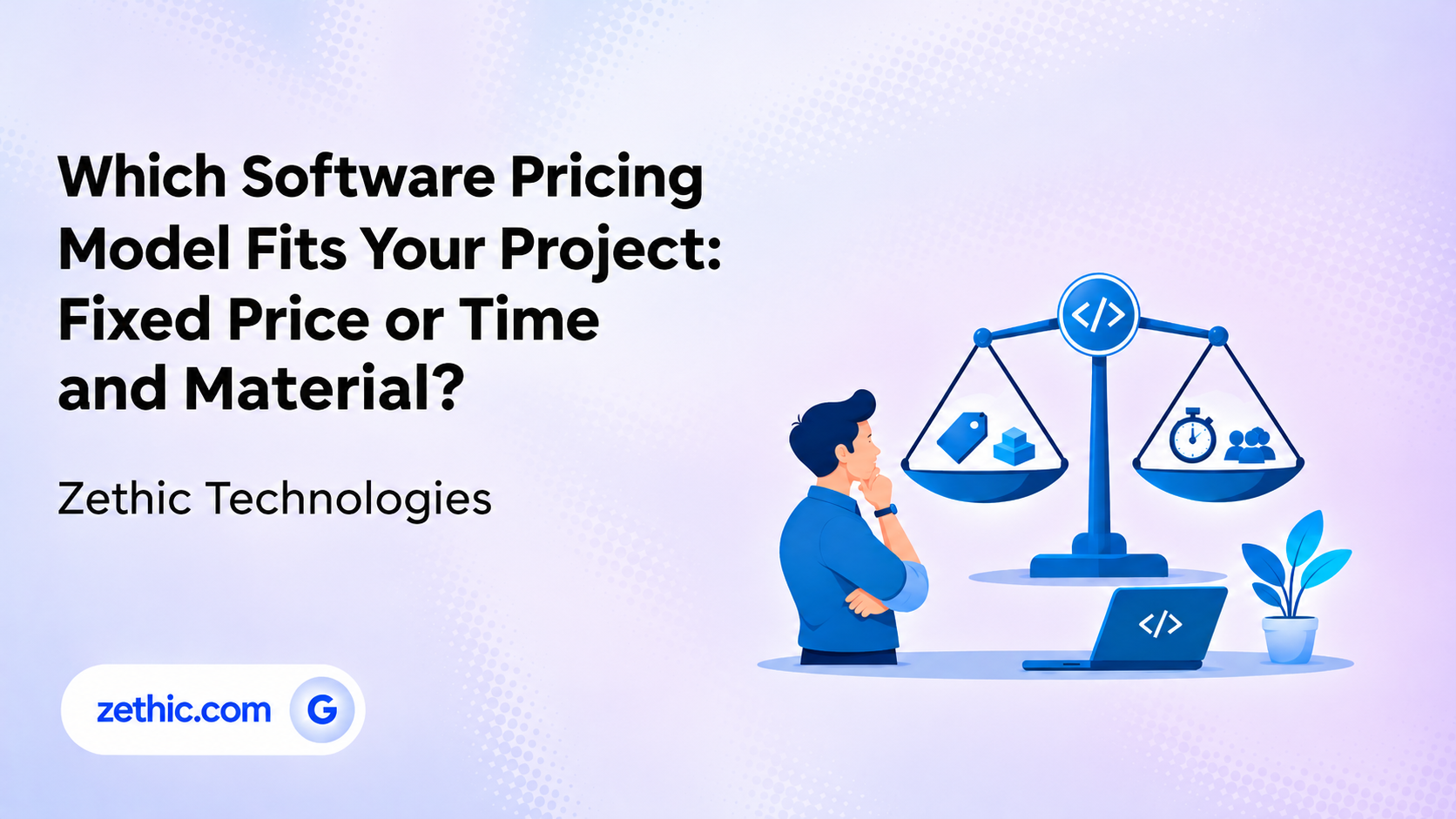
A founder gets two proposals for the same project: one locks in a total price, while the other bills by the hour with no ceiling. Picking the wrong software pricing model changes who carries the risk once requirements shift mid-build. A fixed price that looked safe can balloon through change orders, while a time and materials deal can run past budget if nobody tracks the hours. The real decision is which model matches how certain the scope actually is before work starts, not which one costs less on average.
What Is a Software Pricing Model?
A software pricing model is the billing structure a vendor and client agree on before development starts, covering how work gets priced, who absorbs scope-change risk, and when payment is due. The three common structures are fixed price, time and materials, and hybrid or capped arrangements that blend both. A custom application development project, for instance, is usually quoted as either a fixed-scope price or an ongoing, team-based build.
Each model answers a different question. Fixed price asks what the finished product costs; time and materials asks what the work costs as it happens; and hybrid models ask how much flexibility both sides can accept partway through.
Most disputes between vendors and clients trace back to picking a software pricing model that did not match the project's actual scope certainty, not to either side acting in bad faith. A contract written around the wrong assumption tends to surface that mismatch only when the first change request arrives.
What Is the Difference Between Fixed Price and Time and Material Contracts?
Fixed price and time and material contracts split cost and risk in opposite directions. A fixed price contract sets one total cost for a defined scope, so the vendor carries the risk if the work runs longer than estimated. A time and material contract bills for actual hours and resources used, so the client carries that risk if the project takes longer than planned.
A 2022 U.S. Government Accountability Office review found that time and materials contracts made up about 11 percent of civilian federal agency contract spending between 2017 and 2021, reaching $139 billion. That scale reflects how often agencies value the model's flexibility, even though it shifts cost oversight onto the client side.
|
Criteria |
Fixed Price |
Time and Material |
|
Who carries scope-change risk |
Vendor |
Client |
|
Best fit for |
Locked, well-documented requirements |
Requirements that evolve during the build |
|
Payment structure |
One total cost, often milestone-based |
Billed periodically for hours and resources |
When Does Fixed Price Software Development Make Sense?
Fixed price software development works when requirements are documented in detail and unlikely to change. It suits short, well-scoped projects such as a single feature build or a defined integration.
An MVP development services track is a common example, typically quoted as one fixed price and timeline once the feature set is finalized.
-
The scope, features, and acceptance criteria are written down before the contract starts.
-
The timeline is short enough that business conditions are unlikely to shift mid-build.
-
The client needs budget certainty for internal approval or financing.
-
The vendor has built something similar before and can estimate effort accurately.
When Does a Time and Materials Contract Work Best?
A time and materials contract for software development works when requirements are expected to change as the team learns more. It fits long-running products and projects where the client wants direct input into priorities as the build moves forward. The trade-off is that someone needs to track hours and output regularly, since no single number caps what the build ultimately costs.
-
The product roadmap is likely to shift based on user feedback or market changes.
-
The project runs for months or years rather than weeks.
-
The client wants to adjust priorities or swap features in and out during the build.
-
Full requirements cannot realistically be locked down before coding starts.
Teams planning a monolith to microservices migration face the same question, revisiting the decision as they learn more instead of locking it in at the start.
What Does a Hybrid or Capped Pricing Model Look Like?
A hybrid model splits a project into fixed price phases, often discovery followed by milestone-based development, so neither side commits to one number for the entire build. A capped time and materials contract sets a maximum spend ceiling on top of hourly billing, giving a worst-case number while keeping per-hour flexibility.
Both versions exist because most real projects sit somewhere between fully locked and fully open scope. A blended software pricing model has become the common answer for mid-size builds that fall into that middle ground.
-
Discovery or planning runs as its own fixed-price phase before the main build is priced.
-
Development milestones each carry a fixed price once scope for that phase is locked.
-
A spending cap limits total exposure on a time and material structure that would otherwise have no ceiling.
-
Change requests outside the cap get priced and approved separately before work continues.
Fintech and banking software development work is often split the same way, offered as either a fixed-scope project or a dedicated team rather than one blended contract.
How Do You Decide Which Software Pricing Model Fits Your Project?
Four questions settle most software pricing model decisions before a contract gets signed. Answering them honestly, rather than defaulting to whichever model feels safer, heads off the mismatch that leads to disputes later.
-
How certain is the scope? Locked requirements point to fixed price; evolving ones point to time and materials.
-
How long will the project run? Short, bounded builds suit fixed price; multi-month or multi-year work suits time and materials.
-
How much oversight can the client provide? Time and materials needs regular check-ins to track hours and direction; fixed price needs less day-to-day involvement.
-
How much budget flexibility exists? A hard budget ceiling points toward fixed price or a capped time and materials contract instead of hourly billing with no cap.
A lower bid for machine learning development cost usually means a simpler build, not a better deal, so scope should be compared before price is.

How Can Businesses Choose the Right Software Pricing Model?
The right choice comes down to matching the software pricing model to how well the scope is understood before work starts, not to which model sounds cheaper upfront. A project with locked requirements rarely benefits from the flexibility of time and materials, and a project with evolving requirements rarely survives fixed price without expensive change orders.
Zethic scopes new projects this way before quoting, running a short discovery phase to identify where requirements are firm and where they are likely to shift, then recommending fixed price, time and materials, or a capped hybrid based on that answer. Zethic works with founders and enterprise teams through this same process regardless of which pricing model the project ends up using.