

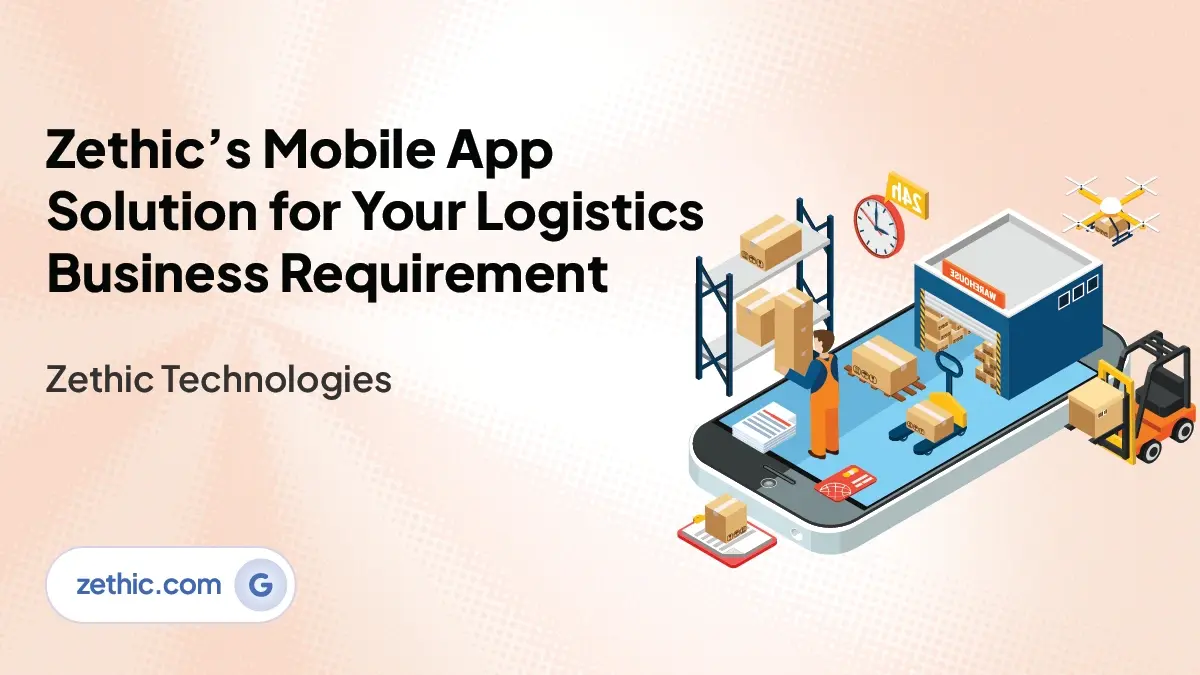
Building a mobile app sounds exciting. A new idea, a big vision, future growth. But once real discussions start timelines, cost estimates, and technical terms clarity often disappears.
At Zethic Technologies Software Development, we speak with founders and business teams every week who ask the same thing:
“What is the actual process of building a mobile app, beyond just coding?”
This blog is for anyone planning to work with a Mobile Application Development Company and wants a clear picture before starting.
Introduction
The role of mobility is increasing rapidly in the Logistics industry. Drivers, warehouse teams, dispatch managers, everyone needs real-time information on mobile devices. For this reason, Logistics businesses are deploying dedicated mobile apps that streamline operations. As a specialist logistics app development company, Zethic builds solutions that connect every layer of the supply chain from fleet to last-mile delivery. Inside large warehouses, where GPS cannot reach, an indoor navigation system guides staff to the right aisle and bin.
Industry insights suggest that Logistics mobile applications improve real-time tracking, route optimization, and delivery coordination, significantly enhancing operational efficiency.
A well-planned mobile solution connects the entire supply chain and reduces manual dependency.
Logistics Operations Breaking Down?
- No real-time shipment visibility
- High fuel & operational costs
- Manual order & inventory tracking
- Delivery delays & poor route planning
- Disconnected systems & data silos
What We Build at Zethic
We design and develop end-to-end logistics software solutions tailored to your operations, scale, and business goals.
Fleet Management Software
Complete visibility and control over vehicles, drivers, and movement are essential for efficient logistics operations. Our fleet management solutions enable real-time GPS tracking, monitor driver performance, and optimize fuel usage through intelligent insights. Maintenance schedules and automated alerts ensure that vehicles remain operational without unexpected downtime, helping businesses reduce costs while improving overall efficiency.
Warehouse Management Systems (WMS)
Efficient warehouse operations depend on accuracy, speed, and coordination across multiple processes. Our warehouse management systems provide real-time inventory tracking, integrate barcode and RFID technologies, and streamline picking, packing, and dispatch workflows. Automated stock updates and demand-based replenishment reduce errors and delays, allowing businesses to maintain optimal inventory levels and faster order fulfillment.
Route Optimization Platforms
Smarter route planning plays a critical role in reducing delivery time and operational costs. Our route optimization platforms use intelligent algorithms to determine the most efficient delivery paths, taking into account traffic conditions, multiple stops, and dynamic changes during transit. Continuous route adjustments ensure timely deliveries while minimizing fuel consumption and improving resource utilization. Businesses looking to take this further can explore AI-powered logistics development, where machine learning adds predictive intelligence to routing decisions.
Real-Time Tracking Systems
Visibility across shipments and operations has become a baseline expectation in modern logistics. Quick commerce software also relies on this real-time visibility to coordinate deliveries effectively. Our real-time tracking systems provide live updates for both internal teams and customers, supported by accurate ETA predictions and automated notifications. A centralized dashboard ensures that every shipment can be monitored at any moment, improving transparency and reducing the need for constant manual follow-ups.
Last-Mile Delivery Apps
The final stage of delivery often defines the customer experience, making efficiency and accuracy crucial. Our last-mile delivery applications equip drivers with intuitive mobile tools for navigation, order management, and status updates. Proof of delivery features such as OTP verification, signatures, and image capture ensure accountability while improving delivery success rates even in challenging conditions.
Supply Chain Automation Solutions
Seamless coordination across multiple systems and stakeholders is essential for scaling logistics operations. Our supply chain automation solutions integrate third-party platforms, automate workflows, and centralize data for better decision-making. End-to-end visibility combined with reduced manual intervention allows businesses to operate more efficiently while preparing for future growth. A dedicated supply chain management solution ensures these automations are built on a reliable, scalable foundation.
LOGISTICS PROCESSES WE DIGITIZE
Order Management
- Multi-channel order sync
- Automated allocation
- Status tracking
Warehouse & Inventory
- Real-time stock updates
- Barcode / RFID integration
- Smart picking & packing
Fleet Management
- GPS tracking
- Driver monitoring
- Fuel optimization
Last-Mile Delivery
- Driver apps
- Proof of delivery
- Smart dispatch
Analytics & Reporting
- KPI dashboards
- Cost tracking
- Predictive insights
CORE FEATURES
Real-Time Tracking
Stay updated with live vehicle and shipment visibility across every stage of delivery, supported by geo-fencing alerts that notify you of delays, deviations, or arrivals instantly.
Route Optimization
Plan smarter deliveries using AI-driven route optimization that identifies the shortest paths while adapting to real-time traffic conditions for faster and more efficient movement.
Inventory Management
Maintain accurate stock levels with real-time synchronization across multiple warehouses, combined with automated low-stock alerts to prevent shortages and disruptions.
Driver Management
Monitor driver activity with attendance tracking and performance insights while ensuring efficient task allocation for smoother day-to-day operations. An online learning management system can also support driver training.
Analytics Dashboard
Access a centralized dashboard that provides clear visibility into delivery performance, operational efficiency, and cost insights to support better decision-making.
Step-by-Step Approach to Build Logistics Mobile Apps
Step 1: Requirement Analysis
Business workflows are defined.
Step 2: UX Planning
User journeys and navigation are designed
Step 3: MVP Development
Testing is done by building a basic version
Step 4: Feature Integration
Tracking, analytics, and automation are integrated
Step 5: Testing and Deployment
Performance and security validation are done
Step 6: Continuous Optimization
Post-launch updates can improve the system
Following a structured process has been the standard approach of a strong logistics app development company. For a comprehensive look at how each phase maps to delivery milestones, the complete logistics app blueprint covers the full deployment journey.
Role of UX in Logistics Mobile Applications
Usability is critical in mobile Logistics apps. Drivers and operators need fast interaction. This is why intuitive dashboards and simple navigation are essential.
Businesses often collaborate with a UI UX design company in Bangalore to simplify complex workflows.
A modern web design ecosystem in Bangalore integrates UX with scalable architecture.
TECH STACK
- Frontend: React, Flutter
- Backend: Node.js, Python
- Cloud: AWS, Azure
- Database: MongoDB, PostgreSQL
- Integrations: GPS, IoT, Payment APIs
Frontend Dashboards (React.js & Angular)
- Real-time operations dashboards with live map views
- Fleet status panels, alert feeds, and analytics charts
- WebSocket-based real-time updates
- Responsive design for tablet and desktop
- Role-based access control for secure usage
Backend Infrastructure (Node.js & Python)
- High-throughput systems for processing GPS data in real time
- Route optimization algorithms and geofencing logic
- Express.js and NestJS for scalable APIs
- Redis for real-time caching and performance
- PostgreSQL with PostGIS for geospatial data
- Message queues like RabbitMQ for async processing
Maps & IoT Integrations
- Integration with Google Maps, Mapbox, and OpenStreetMap
- Real-time vehicle tracking and route visualization
- Support for GPS device protocols such as GT06
- Geofencing setup with automated alerts
- Sensor integrations for fuel and temperature monitoring
Mobile Applications (Flutter & React Native)
- Cross-platform apps for Android and iOS
- Real-time GPS tracking and trip management
- Background tracking for continuous updates
- Offline-first architecture for low network areas
- Push notifications for instant communication
- Camera integration for proof of delivery capture
Cross-platform apps are built using Flutter and React Native for Android and iOS. Flutter’s official documentation explains how its single codebase approach enables consistent, high-performance app delivery across both platforms
Logistics software development cost
Criteria | Basic Logistics Solution | Mid-Level Platform | Advanced AI-Powered System |
|---|---|---|---|
Estimated Cost (INR) | ₹5L – ₹10L | ₹10L – ₹25L | ₹25L – ₹60L+ |
Estimated Cost (USD) | $6,000 – $12,000 | $12,000 – $30,000 | $30,000 – $75,000+ |
Best For | Startups, small fleets | Growing logistics companies | Enterprises, large-scale ops |
Customization Level | Limited | Moderate | Fully custom, scalable |
Fleet Size Support | Up to 50 vehicles | 50 – 300 vehicles | Unlimited vehicles |
Core Features | Basic tracking, order management | Tracking + route optimization + analytics | AI routing, predictive analytics, automation |
Real-Time Tracking | Basic GPS tracking | Advanced tracking with alerts | Live tracking with predictive ETA |
Route Optimization | Static routes | Dynamic routing | AI-based optimization with traffic intelligence |
Integrations | Limited APIs | Payment, GPS, basic ERP | IoT, sensors, enterprise systems |
Mobile App | Basic driver app | Driver + admin apps | Full ecosystem (driver, admin, customer apps) |
Analytics & Reporting | Basic reports | Advanced dashboards | Predictive analytics & insights |
Scalability | Low | Medium | High (cloud-native architecture) |
Maintenance Cost | Low | Moderate | High (continuous optimization) |
The cost of your solution depends on complexity, features, and scale. For a detailed breakdown of what drives these numbers, the logistics app development costs guide covers every pricing factor in depth.
INDUSTRIES WE SERVE
- Freight & Trucking
- Warehousing & 3PL
- E-Commerce Fulfillment
- Pharma & Cold Chain
- Construction & Materials
- Import & Export Logistics
- Courier & Parcel Services
- FMCG Distribution
WHY ZETHIC For Logistics Software Development
Most logistics software fails because it looks good on paper but breaks under real operations. Zethic focuses on building systems that actually handle live tracking, route changes, and operational pressure without slowing down your business.
Instead of pushing pre-built tools, solutions are built around how your fleet, warehouse, and delivery flow actually works. The result is software that stays reliable as you scale, without forcing constant workarounds or manual fixes.
Deployment & Compliance Readiness
- Multi-region cloud deployment on AWS and Azure ensures reliable global performance. AWS’s logistics and transportation solutions page outlines how cloud-native infrastructure supports real-time data processing at scale.
- Architecture designed to handle real-time data and scalable operations
- GDPR-ready systems with secure data handling practices
- Seamless API integrations with global logistics networks and platforms
- Built-in support for multi-currency transactions across regions
- Multi-language capabilities for diverse operational environments
Choosing the Right Logistics App Development Company
It is important to choose the right partner.
A strong Logistics software development company should:
- ✔ provide end-to-end logistics software development services
- ✔ build scalable transportation software solutions
- ✔ integrate real-time tracking
- ✔ support supply chain automation
A capable custom logistics mobile app development company is able to fulfill modern logistics requirements. Understanding Zethic’s app building process including script types, features, and steps gives businesses a clear picture of how delivery is structured
Final Thoughts
Logistics mobile apps are transforming operations.
They:
- improve visibility
- reduce delays
- enhance coordination
- support scalability
Companies that have worked with experienced supply chain software development services, reliable logistics software development companies, and strategic partners like Zethic Technologies have been able to deploy efficient Logistics systems.
The right mobile solution can make a logistics business future-ready.